"Zero Prep" sounds like the absolute holy grail for every stressed game master. On Reddit and in forums, people often promise you can run a brilliant TTRPG one-shot with no notes, no NPC list, and no plan — armed only with good vibes and a set of dice.
The honest and far more useful answer for you: zero prep is a myth — at least if you care about cohesion, fairness, and a compelling plot. Low prep, on the other hand, is absolutely doable if you laser-focus your preparation on what actually matters at the table.
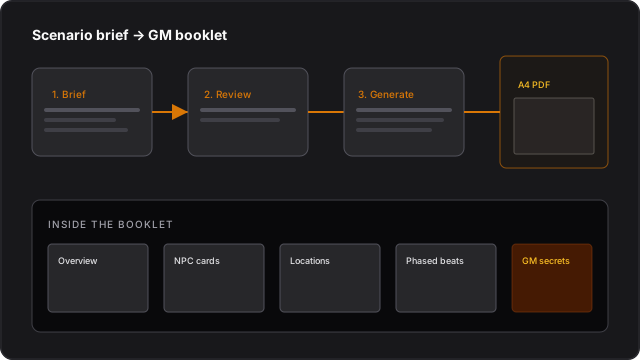
This guide shows you what you can cut from RPG session prep without worry, what must stay, and when an AI-assisted GM booklet — like the RPG one-shot generator from AdventureEngine — literally saves the night before a last-minute session.
What "zero prep" really means in the community
When TTRPG players talk about "zero prep," they usually mean one of three things:
- Pure improv theatre: The GM shows up with only a premise and builds the world live with the players (co-creation).
- Minimal notes: A single index card with the antagonist's name and one twist — everything else is improvised.
- Tool-assisted prep (the sweet spot): A structured generator delivers a runnable outline in minutes. The GM reads through the material and reviews it.
Only the third approach reliably delivers structured one-shots for genres like mystery, horror, heist, and investigation. The first two can be magical with a veteran group — but they are highly risky when your players expect logical clues, clear phases, and a fair chance to solve the case.
Why zero prep is impossible for mysteries
Mystery and crime pen-and-paper sessions have a ruthless core requirement: players must uncover an objective truth about the world through play. That strictly requires GM knowledge — who did it, where is the artifact, who is lying? And it requires at least two to three logical paths for that truth to come to light.
Without solid structure, the following happens at the table inevitably:
- Deadly dead ends: The group misses the improvised clue. You have to rescue them with a sudden, unnatural handout that feels like railroading.
- Continuity breaks: An NPC suddenly contradicts a fact you declared true twenty minutes ago.
- Pacing collapse: Players blindly search room by room because no clean beat outline drives scenes forward.
- Unfair resolutions: The case is solved from the gut, not from deductively discoverable clues.
That does not mean you need twenty pages of prose. It means you need the right 20 percent of prep — the hidden truth, clue paths, and phases.
Zero prep collapses without a skeleton. Low prep delivers the 20% of structure that matters.
What low prep really looks like (focus over volume)
Low prep GMing does not mean being lazy. It means focused preparation. You build a skeleton, not a novel.
| Prep element | Low prep (keep!) | Over-prep (cut!) |
|---|---|---|
| Hidden truth | One crystal-clear sentence (GM only). | Ten pages of background lore nobody queries. |
| Clue paths | 2–3 paths to critical facts. | Naming every useless object in every room. |
| NPCs | Motive + secret + scene hook. | Two-page monologue backstory. |
| Locations | One searchable detail + direct case tie-in. | Mapping every single drawer. |
| Story beats | 3–5 flexible phases. | Pre-written dialogue trees for every branch. |
| Handouts | Only real key documents. | A whole folder of irrelevant props. |
Low-prep GMs arrive at the table with a stable story skeleton. Color, dialogue, and direct reactions are improvised calmly within that safe frame. That harmonizes perfectly with the three-clue rule.
What you can cut without worry (especially last-minute)
If your session is tomorrow night, grab the red pen:
- Long read-aloud text (boxed text): Players interrupt you after two sentences anyway.
- NPC monologues: If an NPC has no secret or actionable hook, a name and a quirk is enough.
- Empty rooms: Locations with no searchable clues or story connection only waste play time.
- Complex side plots: Anything that does not touch the core truth or the finale goes.
- Perfect battle maps: A rough sketch or theater of the mind (with two memorable details) is enough for almost everything.
- Full stat blocks for every NPC: Prep only unavoidable combatants. Improv social NPCs with a simple motive.
Once the skeleton stands, prep time shrinks from six hours to a relaxed ninety minutes.
What you should NEVER cut
- A clear hidden truth (GM only). Without a real answer, there is no fair investigation.
- At least two clue paths — three is optimal (the three-clue rule).
- Phased beats. A defined beginning, middle, and climax — even if players scramble the order.
- An epilogue hook. For when the group solves the puzzle extremely early.
- Genre clarity. Are we playing survival horror, a comedy heist, or a cozy mystery? Tone sets expectations.
Skip these and you quickly turn "zero prep" into "zero fun."
Last-minute workflow: from idea to print-ready booklet in 15–30 minutes.
The perfect last-minute workflow for game masters
When you need to pull a print-ready one-shot out of thin air in one evening:
- The hook (2 sentences): Who needs help, what went wrong, why now?
- The truth (1 sentence): For your eyes only.
- The cast: Design three NPCs and two locations — each with at least one clue thread.
- The beats (3 to 5): Inciting incident, investigation, complication, confrontation, epilogue.
- Dead-end check: Is the truth still reachable if players completely ignore your favorite scene?
- Generate booklet: Skim GM sections once and export PDF.
Steps 1 through 5 often take only five to fifteen minutes with a clear outline. If you generate the finished booklet, you reach the finish line unbeatable fast.
When an AI game master tool saves the night
General chatbots (like ChatGPT) are great for wild brainstorming — names, tavern flavor, random encounters. They fail spectacularly at consistent GM booklet structure: they forget clues, wreck layout, and mix GM secrets with player handouts.
The RPG one-shot generator changes that:
- The scenario wizard guides you to a solid outline in minutes.
- Review before generation lets you close logic gaps before text is written.
- Phased beats with connected threads guarantee smooth play.
- A print-ready A4 PDF saves you any layout chaos in Word.
You remain the game master. You review AI drafts before the session — just like with any purchased module. The only difference: it is tailored exactly to your group and done in record time. (More: ChatGPT vs AdventureEngine for game masters.)
Low prep across RPG genres
The core skeleton stays the same with low prep, but the emphasis varies by genre:
- Horror & Cthulhu investigation: Full focus on hidden truth and clue paths. Oppressive atmosphere you improvise live at the table.
- Heist & espionage: Focus on the target, security gaps, and time pressure in beats. Deep NPC drama is secondary.
- Fantasy dungeons (D&D/Pathfinder): Rooms need searchable details (traps/loot), not novel chapters. Boss motivation is enough as the truth.
- Sci-fi & cyberpunk: Focus on terminal printouts and logs (document clues). Locations act as nodes in a network.
The RPG one-shot generator is rules-agnostic. You translate generated fiction and structure into your system's mechanics. (More inspiration: use cases.)
Myths debunked
Myth: "Really good GMs never prep."
Reality: Good GMs prep extremely efficiently — or use modern tools that handle that essential structure for them in minutes.
Myth: "Players want pure, boundless improvisation."
Reality: Players want agency in logically solvable scenarios. Only thoughtful clues and beats enable real agency because decisions have consequences.
Myth: "AI prep replaces the game master."
Reality: AI delivers the tedious structural work. You edit, regulate pacing, and make final calls at the table. (See About AdventureEngine.)
Myth: "A one-shot needs less design than a campaign."
Reality: A one-shot needs much tighter design. You have only one session for hook, middle, and payoff.
Frequently asked questions (FAQ)
Can I really plan a working one-shot in 5 minutes?
The basic skeleton? Yes — provided your hook and truth are crystal clear. Add review and app generation and you usually stay comfortably under 30 minutes total.
When is "zero prep" occasionally okay?
Light comedy RPG, spontaneous team-building, or building worlds completely free-form with very experienced players. For real mysteries or heists, zero prep is usually a marketing slogan, not a working plan.
Do I have to print the generated GM booklet?
No — a tablet at the table is plenty. PDF export is optional but optimized to look fantastic on A4 paper at the table.
How does this relate to purchased adventure modules?
Published modules are licensed full adventures from publishers. AdventureEngine is a tool that expands your own short ideas. It does not replace thick rulebooks.
Which game systems is this for?
Absolutely any system. The app delivers story, fiction, and structure. You add the hard mechanics (dice rolls, DCs, damage) for D&D 5e, Call of Cthulhu, or Fate yourself.
How do I know if my prep is "enough"?
The ultimate test: if you can state the hidden truth in one sentence and your notes show at least two completely independent paths for players to find that truth, you are ready to run.
Next steps for relaxed game masters
Low prep is how pros work. Zero prep is a myth.
End prep stress: Start your RPG one-shot and hold a structured, print-ready GM booklet for your next session in minutes.
Turn your idea into a GM booklet
Structured NPCs, phased beats, and print-ready PDF — review everything before you generate.
- Rules-agnostic one-shot prep
- Preview matches your PDF
- Free to try
More articles
ChatGPT vs AdventureEngine for game masters
Compare ChatGPT and AdventureEngine for TTRPG one-shot prep: structured GM booklets, clue threading, print-ready PDF export, workflow, cost, and when to use each AI tool.
The three-clue rule, automated for your table
Complete guide to Justin Alexander's three-clue rule for TTRPG mystery prep: clue structure, phased beats, GM checklist, and how AdventureEngine wires independent paths in printable one-shot booklets.