If you have ever watched your painstakingly planned mystery one-shot die a slow death at the table because the group missed the one relevant clue, you know the pain. That is exactly why the three-clue rule belongs in every serious game master's prep toolkit.
Justin Alexander popularized this principle for pen-and-paper RPGs: every essential fact in a crime or mystery must be discoverable through at least three independent paths.
This guide explains how the rule works at the table, how to avoid plot holes, and how the Mystery & investigation RPG generator uses AI to generate structured, print-ready GM booklets that already weave these life-saving clue threads together perfectly.
What the three-clue rule really means
The three-clue rule is not a game mechanic — it is a fundamental scenario design principle. It states:
If players must uncover a specific truth to move the story forward (e.g. who the murderer is, where the artifact is hidden, which NPC is lying), they must be able to reach that truth through at least three completely separate paths.
The key word here is independent. Three NPCs parroting the exact same rumor in the tavern count as one clue, not three. Three different sources — a heated witness interview, a torn receipt in the trash, and a bloodstain at the crime scene — count as three distinct paths.
For GMs running RPG one-shots, this is survival-critical. You have only this one session — no next week to elegantly repair a dead end. The three-clue rule gives you fair, resilient investigation scenarios without railroading players on invisible rails.
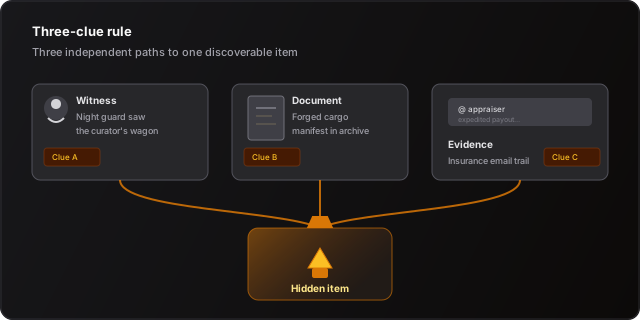
Three independent clues — witness, document, evidence — all point to the same item.
Why one-shots stall without clue redundancy
Most pen-and-paper mysteries fail for highly predictable reasons:
- The bottleneck clue: One failed Perception check, a botched interrogation, or an unvisited room — and the entire plot stops cold.
- NPC knowledge bottlenecks: Only one character knows the secret. The group forgets to ask them, or accidentally eliminates them in scene one.
- Rigid beat order: Scene 3 logically assumes evidence was found in scene 2. Skip scene 2 and the adventure collapses.
- Empty subplots: Side threads that eat an hour of play and deliver nothing usable for the case.
The result? The game master improvises under enormous pressure. Sometimes that produces magic; far more often, confused players, sluggish pacing, and massive prep frustration. The three-clue rule does not take improvisation off the table — it gives you a safety net.
Left: a single clue stalls the session. Right: three paths keep the investigation alive.
Three clues vs. three copies of the same tip
This is the most common mistake when writing RPG mysteries. A good clue advances the investigation from different angles.
| Clue approach | Example at the table | Counts as three clues? |
|---|---|---|
| Copy (same fact, same source) | Three different books in the library mention the cult's name. | No — counts as one clue only. |
| Redundancy (same fact, different sources) | An NPC rumor + a crime scene photo + a hidden lease agreement. | Yes — three independent paths. |
| Complex (related but different facts) | Motive found + opportunity proven + murder weapon secured. | Partially — at least one find must lead directly to the core truth. |
| Sequential (linear path) | Clue B can only be deciphered after clue A is found. | No — that is a bottleneck, not a safety net. |
Excellent clue structure spreads information across people, places, and documents. In a well-designed game master prep tool, that maps to NPC cards, location descriptions, and phased beats.
What good clue structure looks like at the table
1. Scatter your sources: people, places, evidence
Think in three simple buckets when prepping:
- People (social): Who saw something? Who benefits from the crime? Who starts sweating when you ask about Tuesday night?
- Places (exploration): Which physical detail at the scene contradicts the official story from the guards?
- Evidence (investigation): Receipts, diaries, lab reports, chat logs — tangible props for players.
If each bucket contains a thread to the hidden truth, you have created natural, robust redundancy that rewards every player type.
2. Use phased beats instead of a linear script
Good mysteries use phased beats (scenes or story phases) that can run in flexible order. Beat 1 is the inciting incident. Beat 2 is interrogations. Beat 3 is the confrontation at the docks. If the group rushes straight to the docks, beat 2 still works — the NPCs react to the dock event instead. That is the heart of rules-agnostic TTRPG prep, whether you run D&D 5e, Call of Cthulhu, or a homebrew system.
3. Layer NPC secrets and competing theories
Strong mysteries rarely need empty side threads. Instead, give each suspect real secrets:
- They reveal world knowledge or motives that matter later.
- They create tension when players must decide whom to trust.
- They explain why someone acts guilty without blocking progress toward the truth.
Step by step: applying the rule to your next one-shot
Use this simple workflow for game master prep before you lose yourself in endless NPC monologues:
- Define the hidden truth (GM only). One crystal-clear sentence: "The curator staged the theft to smuggle the real relic out with the insurance payout."
- List three discovery paths.
- (A) A forged shipping manifest in the archive.
- (B) A frightened night guard saw the curator's car.
- (C) An adjuster's email mentions an expedited payout.
- Assign each path to a beat and a source. Hide path A in a location search in beat 2. Use path B in an NPC interview in beat 1. Hand out path C as a prop at session start.
- Check independence. Does your plot collapse if path A is ignored? If yes, fix it.
- Set an "early win" clue. Give the group early proof that does not solve the case but shows their investigation methods work.
For a tight one-shot, doing this by hand takes 15 to 30 minutes. With specialized AI tools, it takes seconds.
Common mistakes in clue placement
- Info dumping in scene 1: Too many clues on a silver platter immediately — nothing feels earned.
- Desert in the middle: The group circles and waits for the GM to nudge them onto the right trail.
- Skill checks as hard barriers: If a clue can only be found with Thieves' Tools or only with Library Use, you exclude party members.
- No GM truth document: If you improvise secrets without a consistency check, you tangle yourself up by the end.
A structured, print-ready GM booklet with overview, run guide, and outline prevents exactly these mistakes.
How AdventureEngine automates the three-clue rule
The Mystery & investigation RPG generator is a dedicated TTRPG prep tool that turns your loose scenario ideas into logically structured, print-ready A4 booklets for game masters. It is built precisely for one-shots where clue threads and pacing are essential.
When you describe your idea (hook, setting, cast, locations, hidden truth), the engine intelligently links NPCs, locations, and story beats. The key: you review the outline and truth before final text generation. That is the perfect moment to ask: "Do I have my three independent paths?"
The finished GM booklet gives you:
- A compact scenario overview including all GM secrets.
- Clear NPC and location cards with integrated motives and scene hooks.
- Logical phased beats you can run flexibly at the table.
- Clean PDF export that looks exactly like your preview.
The AI handles the grunt work, but the focus stays on watertight fiction and structure. (How this differs from general chatbots: ChatGPT vs AdventureEngine for game masters.)
Practical GM checklist before session
- I can summarize the hidden truth in a single sentence.
- At least three independent paths lead to that truth (via people, places, or documents).
- Every story beat introduces or reinforces at least one clue thread.
- Each suspect's secrets and motives add tension without creating dead ends.
- One failed roll or missed room cannot end my scenario.
- I have read the entire GM booklet (including secret sections).
- Players know which genre contract we are playing today (e.g. noir mystery, heist, cosmic horror).
For ultimate last-minute prep, an AI-generated outline plus review beats improvised index-card chaos. (See also: Zero-prep GMing: myth or doable?).
Frequently asked questions (FAQ)
Who invented the three-clue rule?
It was articulated by Justin Alexander (The Alexandrian) for pen-and-paper scenario design. The principle itself comes from classic mystery fiction: protagonists (and players) should not be punished for missing a detail once.
Does this only work for mysteries, or also horror and heists?
It works for every genre! Anywhere a hidden truth must be discovered — dark cosmic horror rituals, the weak point in a heist vault, a spy's true identity.
How many clues is too many?
When your players drown in noise and can no longer filter which threads really matter. It is about three paths to critical facts, not every irrelevant background detail.
Can AI write my clues flawlessly?
AI can draft brilliant dialogue, documents, and beats. Logic checking remains your job as game master. That is why AdventureEngine enforces a review step before the final PDF is generated.
Can I rewrite published adventure modules with this?
Use these tools to design your own one-shots. Copying copyrighted module text into AI generators is legally problematic.
Next steps
Ready to banish chaos from your notes and spin watertight clue threads? Start your mystery investigation now — define hook, cast, and hidden truth, review the outline, and generate your print-ready GM one-shot in minutes!
Turn your idea into a GM booklet
Structured NPCs, phased beats, and print-ready PDF — review everything before you generate.
- Rules-agnostic one-shot prep
- Preview matches your PDF
- Free to try
More articles
ChatGPT vs AdventureEngine for game masters
Compare ChatGPT and AdventureEngine for TTRPG one-shot prep: structured GM booklets, clue threading, print-ready PDF export, workflow, cost, and when to use each AI tool.
Zero-prep GMing: myth or doable?
Honest guide to low-prep vs zero-prep game master workflows for TTRPG one-shots: what to cut, what to keep, last-minute session prep, and when AI GM booklets save the night.